
Key Takeaways:
- SEO drives high-quality leads for manufacturers. 69% of manufacturers generate sales-qualified leads through organic search. This makes SEO a proven growth channel in the industrial space.
- Tailored strategies deliver better results: Keyword targeting and technical optimization are key elements. Local SEO and content marketing play crucial roles too. A manufacturing-specific SEO approach attracts the right buyers at every stage.
- Long-term visibility requires data and consistency: You need ongoing performance tracking. Backlink building is important. Content refinement is essential for sustaining rankings and growing online authority.
In today’s digital-first industrial landscape, manufacturers face increasing pressure to stand out, reach the right buyers, and drive sustainable growth. Search engine optimization (SEO) has become a crucial tool in this effort. It helps companies boost visibility and attract sales-qualified leads. SEO also enables them to compete more effectively online. In fact, 69% of manufacturers generate SQLs through organic search. This is according to IndustrialSage. This proves that SEO isn’t just optional. It’s a competitive advantage.
What Is Manufacturing SEO?
Manufacturing SEO is the process of optimizing your website and digital presence specifically for the industrial and B2B manufacturing space. It helps your products, services, and technical content rank higher in search engine results. This is crucial when potential buyers—engineers, procurement teams, or business owners—are researching solutions online. Whether you’re targeting local distributors or global OEMs, adopt a strong SEO strategy. This approach ensures your company gets discovered by the right decision-makers. It reaches them at the right time.
Why is this crucial?
- Increased Visibility: Today’s industrial buyers start their research online. They include engineers, procurement managers, and supply chain leads. They conduct this research before ever reaching out to a supplier. If your manufacturing website isn’t ranking for the right keywords, those buyers will find and engage with your competitors instead. SEO ensures your products, capabilities, and specifications are visible at the top of search results when buyers are actively looking.
- Enhanced Authority:
Appearing in top search results doesn’t just increase clicks—it builds credibility. In the manufacturing space, trust and technical confidence are everything. A well-optimized website consistently appearing for industry-specific queries establishes that your company is knowledgeable. It also positions your company as a leader in its niche. This authority can influence vendor choice and long-term business relationships. - Higher ROI: Unlike paid ads that stop driving traffic once the budget runs out, SEO delivers sustained, cost-effective results. Organic traffic often has stronger buying intent, especially when targeting specific manufacturing terms or applications. Over time, SEO compounds—improving rankings, lead volume, and cost efficiency. For manufacturers with long sales cycles or complex offerings, this long-term visibility translates to better-qualified leads and higher conversion rates.
SEO Approach
To succeed in the increasingly competitive and digital-first manufacturing sector, it’s not enough to simply have a website. You need a strategic SEO approach tailored to how industrial buyers search, evaluate, and select suppliers. Manufacturing SEO must handle technical complexity, long sales cycles, and niche search behavior. A one-size-fits-all strategy won’t cut it.
1. Keyword Research
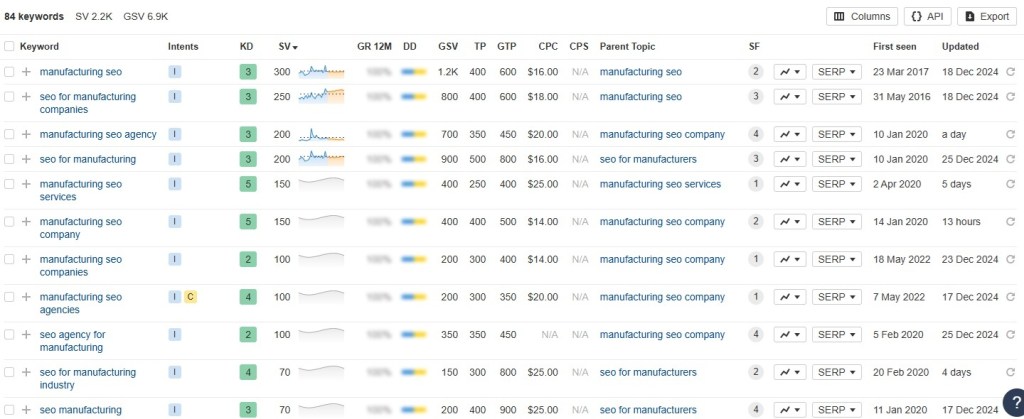
A keyword research tool displaying data for manufacturing-related SEO keywords.
Effective SEO in the manufacturing industry starts with precision-targeted keyword research. Unlike B2C, industrial buyers use more technical, application-specific language and often search for particular capabilities or certifications. Your goal is to find the exact terms your ideal customers use. Optimize for these terms at every stage of their buying process.
- High-intent keywords: Focus on keywords that signal readiness to act. Look for terms like “custom CNC machining quote” or “ISO 9001 certified injection molding.” These searches often show the user is ready to make a buy. They also ask for a quote, not just browse.
- Keywords to offerings: Ensure your keywords directly highlight the products, services, materials, or capabilities you offer. This alignment brings in qualified leads who are actively looking for solutions you supply. It is stainless steel fasteners, plastic extrusion, or laser cutting services.
- Strategic approach: Don’t just target broad terms like “metal fabrication.” Include long-tail and niche-specific queries like “aerospace sheet metal forming” or “aluminum CNC milling for automotive parts.” This allows you to reach specialized audiences with less competition and more intent.
- Comprehensive research: Map out keywords across the entire buyer journey. Start from discovery with phrases like “types of industrial 3D printing.” Move to comparison, like “SLA vs SLS printing for tooling.” Finally, tackle buying intent with terms like “get a quote for SLS 3D printing.” This ensures you’re available at every decision point.
- Tailored content: Use your keyword insights to create content that answers the specific needs of manufacturing buyers. This content is detailed blog posts, specification sheets, or case studies. These should explain how your solutions solve real problems.
- Right traffic: The goal isn’t just more traffic—it’s better traffic. By targeting keywords with strong buy or inquiry intent, you attract visitors who are more to convert into leads. These visitors turn into RFQs or customers.
This keyword-driven approach forms the foundation of a high-performing manufacturing SEO strategy.
2. On-Page Optimization

A webpage showcasing services for plastic injection molding.
In the manufacturing space, every page should be treated as a sales asset. This includes product details, capability overviews, and case studies. Proper on-page optimization ensures that these pages rank well on search engines. It also converts technical buyers, procurement officers, and engineers into real leads.
- Search-engine friendly: Start by making your content easy for search engines to crawl (discover) and index (store and organize). This involves having a clean web address structure. Use appropriate header tags, like H1, H2, and H3. Make sure each page has a clear purpose and hierarchy.
- Keyword optimization: Integrate relevant, high-intent keywords into strategic locations like:
- Title tags
- Meta descriptions
- Headings (H1–H3)
- Body copy
- Image filenames and alt text
- For example, instead of “Capabilities,” use “CNC Milling Services for Aerospace Components” to improve relevance and ranking.
- Content clarity & structure: Manufacturing buyers look for precision and detail. Make sure your content is:
- Structured with bullet points, subheadings, and clear sections
- Easy to scan, with technical terms defined where needed
- Rich in useful data like tolerances, lead times, and certifications
- Search intent: Not all visitors are at the same buying stage. Some are researching processes (e.g., “how does powder coating work”), while others are ready to engage (e.g., “powder coating services”). Tailor your page content to tackle those specific needs—answering questions, showcasing solutions, and prompting next steps.
Well-optimized manufacturing pages don’t just rank better. They guide visitors to take meaningful actions. These actions include submitting RFQs, calling your sales team, or downloading technical spec sheets.
3. Technical SEO
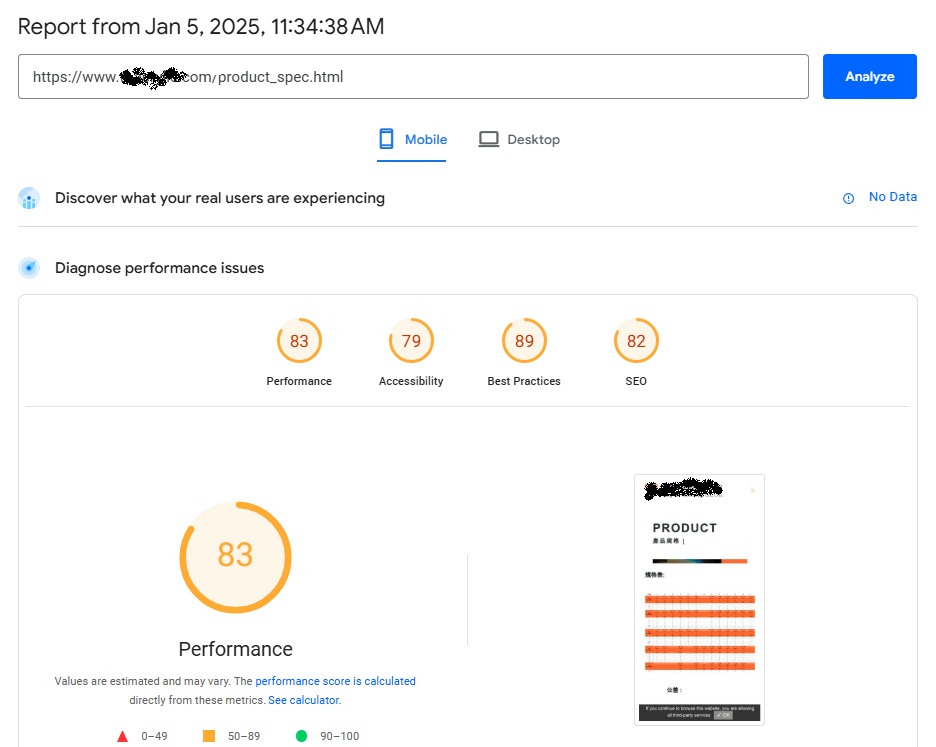
A Lighthouse performance report for a mobile-optimized manufacturing product page.
Manufacturing websites often carry a heavy load—complex product catalogs, detailed technical documents, and dense specification pages. Without strong technical SEO, the most valuable content remains invisible to search engines. It can also become frustrating for users to navigate. Addressing technical performance is essential for both discoverability and usability.
- Complex information: Manufacturing websites typically feature:
- Large SKUs or product databases
- PDFs or CAD file downloads
- Technical datasheets and compliance documentation
- While informative, this complexity can overwhelm visitors and search engines if not structured properly.
- User experience: Enhance site navigation and organization by:
- Streamlining your site architecture (e.g., use logical URL paths and category groupings)
- Creating intuitive menus based on product types, industries served, or solutions
- Reducing click-depth so users can access key pages within 1–3 clicks
- This makes it easier for buyers to find the right information, send RFQs, or explore solutions.
- Page speed: Slow-loading sites are a major turn-off. This is especially true for engineers or buyers viewing specs on the shop floor or on the go.
- Key improvements include:
- Image optimization (compressing without losing clarity, especially for product visuals)
- Minimizing scripts and leveraging browser caching
- Ensuring responsive design so pages load and run smoothly across devices
- With mobile usage rising even in industrial sectors, mobile compatibility is now a must—not a nice-to-have.
When technical SEO is done right, it supports search engine visibility. It also delivers a seamless experience that drives more qualified traffic. This leads to better conversion rates.
4. Local SEO
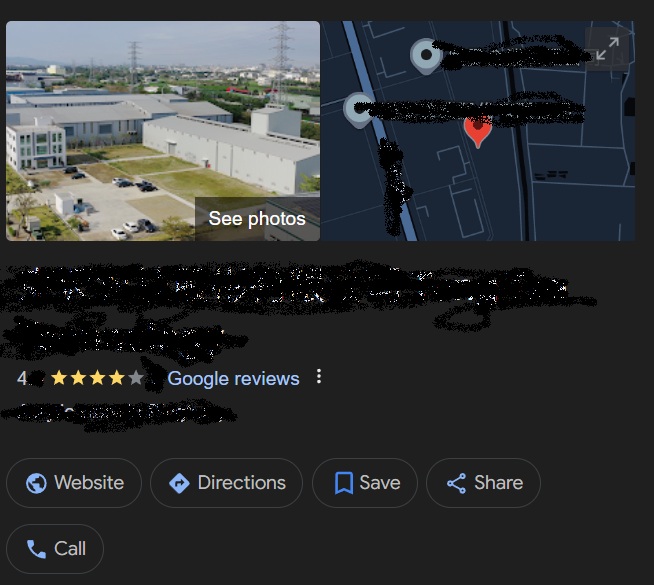
An optimized Google Business Profile for a manufacturing company.
Even if you serve a national or global customer base, your manufacturing facility is rooted in a physical location. That matters. Many B2B buyers search for local suppliers to reduce shipping costs, guarantee faster turnaround times, or source regionally-compliant parts. That’s why Local SEO plays a critical role in helping manufacturers show up in geographic-specific search results.
- Google My Business: This free tool from Google lets you manage how your company appears across Google Search. It also lets you manage how your company appears on Google Maps. For manufacturers, it’s often the first touchpoint for local procurement teams or engineers searching for nearby partners. A well-optimized listing can significantly increase visibility, especially for searches like:
- “metal stamping supplier near me”
- “precision machining Taichung”
- “ISO-certified factory Taipei”
- Optimize listing: Keep your profile detailed and current to build trust and encourage clicks:
- Business name, location, and phone number (NAP) must be consistent across all platforms.
- List services offered (e.g., CNC milling, plastic injection molding, prototyping).
- Add high-quality photos of your facility, equipment, team, and recent work.
- Post updates about new certifications, capabilities, or client wins.
- Respond to reviews—especially positive ones—to show engagement and build social proof.
- Local visibility: Appearing in the Google Map Pack includes the top 3 local listings in a search. This visibility increases click-through and RFQs from nearby businesses. To improve your chances:
- Get listed in local manufacturing directories or chamber of commerce websites.
- Include location-based keywords on key web pages (e.g., “plastic extrusion specialist”).
- Add structured data (LocalBusiness schema) to your website to help search engines understand your regional relevance.
Local SEO connects your digital presence with your physical operations. It helps your factory, plant, or office stand out when local buyers are ready to act. It’s an essential tactic for any manufacturer looking to grow market share within their geographic footprint.
5. Content Marketing
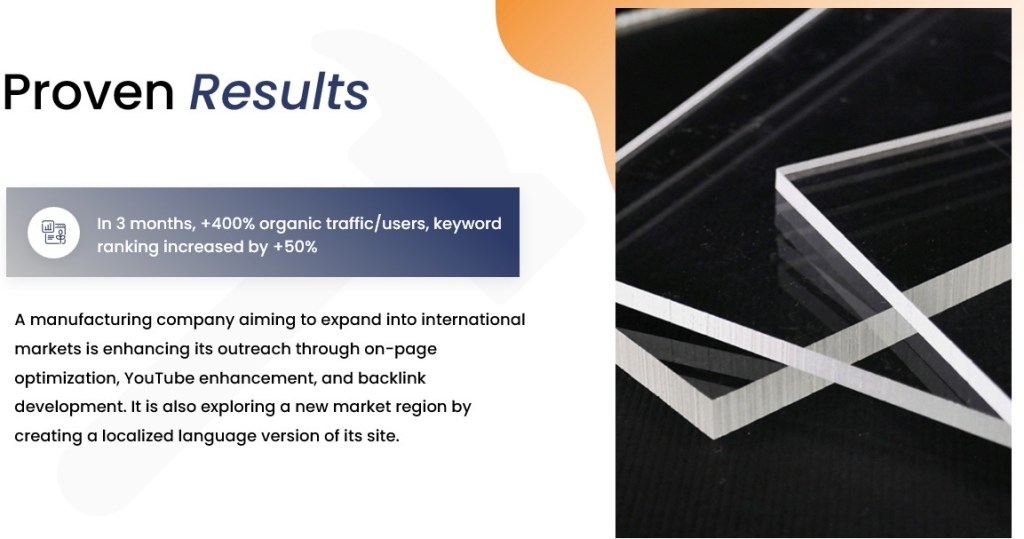
A case study demonstrating successful outcomes for a manufacturing company looking to expand internationally.
In the B2B manufacturing space, purchasing decisions are driven by trust, technical confidence, and proof of ability. That’s why content marketing isn’t just about brand awareness. It’s about demonstrating skill. It involves solving real-world problems. Additionally, it guides buyers through complex decision-making processes.
- Industry knowledge: Manufacturing buyers—whether they’re engineers, procurement managers, or plant supervisors—want to work with partners who deeply understand their industry. Content is your chance to prove that knowledge before they ever contact your sales team. Your content should show:
- Technical knowledge
- Familiarity with regulatory standards
- Proven problem-solving experience in your vertical (e.g., aerospace, medical, automotive)
- Professional content: Use content to explain your capabilities, processes, and advantages in a way that educates and builds confidence. Key formats include:
- High-quality blogs – Cover topics like “How to Choose the Right CNC Material for Aerospace.” They also tackle “What Makes ISO 13485 Certification Critical in Medical Device Manufacturing.”
- Case studies – Walk prospects through real-world scenarios where your solutions delivered results. Include metrics, visuals, and client quotes.
- Videos – Use factory tours, equipment demos, or team interviews to visually highlight what sets your operation apart. Videos are highly engaging and work well on your site and social media.
- Real-world applications: Manufacturers value practical solutions over marketing fluff. Your content should:
- Tackle common customer pain points
- Explain how your products/services solve specific challenges
- Use technical language appropriately while remaining accessible to decision-makers
- Content marketing for manufacturers isn’t about volume—it’s about value. When done right, your content becomes a trust-building tool that guides potential clients from first discovery to RFQ submission. It sets you apart as a knowledgeable, reliable, and capable partner in their supply chain.
6. Backlink Strategy
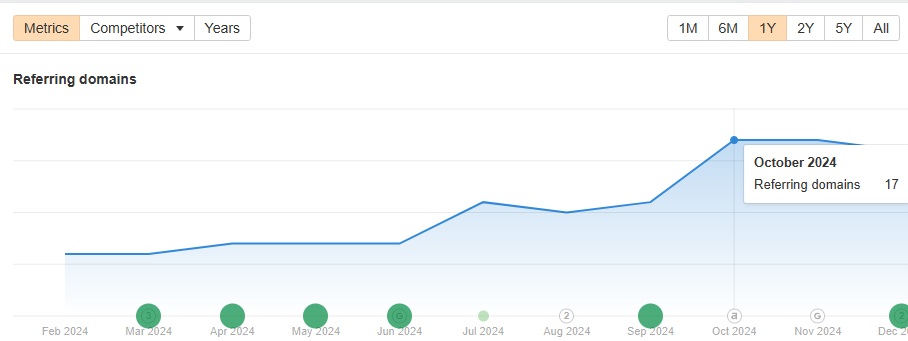
A report illustrating the growth in referring domains for a manufacturing website over the course of 4 months.
Backlinks—links from other websites to yours—are one of the strongest ranking signals in Google’s algorithm. For manufacturers, earning backlinks from reputable industry sources boosts search engine visibility. It also validates your skill. Furthermore, it builds trust with technical buyers and procurement professionals.
- Why: In manufacturing SEO, backlinks from authoritative, relevant sites help:
- Improve your domain authority, which directly influences your ability to rank for competitive keywords
- Signal trust to search engines and users alike
- Drive referral traffic from targeted audiences like industry professionals, trade journals, or engineering communities
- Approaches: Don’t pursue links randomly—focus on credible, manufacturing-adjacent sources. Effective tactics include:
- Guest posts: Write educational or technical articles for trade publications, association blogs (e.g., SME, MFG, Thomasnet), or B2B platforms.
- Topics include manufacturing innovation, process optimization, sustainability, or material choice.
- Within your author bio or article body, include a natural backlink to your site.
- Industry directories: Send your business to trusted manufacturing directories with strong SEO value, like Thomasnet, Kompass, or GlobalSpec.
- Press coverage: Share company milestones (e.g., new facility, certifications, partnerships) with trade media outlets to earn editorial mentions and backlinks.
- Partnerships: Collaborate with suppliers, clients, or associations for co-authored content or case studies that can be shared across both websites.
- Guest posts: Write educational or technical articles for trade publications, association blogs (e.g., SME, MFG, Thomasnet), or B2B platforms.
- Benefits: A strong backlink profile doesn’t just help rankings—it improves your brand’s position in the industry:
- Boosts visibility: Show prominently in Google search results for product and service-related queries
- Builds authority: Shows potential clients that your company is respected within the manufacturing community
- Strengthens relationships: Partnering with others for content or cross-promotion opens the door to new business opportunities
- Generates qualified traffic: Backlinks from niche sources bring in users who are ready to convert.
- Manufacturers often focus on tangible capabilities, but in today’s digital landscape, authority and visibility are just as vital. A thoughtful backlink strategy helps your site rise in rankings while reinforcing your reputation as a trusted, high-performing industrial partner.
7. Analytics and Reporting

A Google Analytics 4 dashboard showcasing the growth in user activity for a manufacturing website over six months.
Title/Heading: Number of user traffic over a period (GA4)
Date Range on X-Axis: The months are labeled from October to March 2024.
Data Point at March: 256 users recorded up to March 30.
Y-Axis: Indicates user count, ranging from 0 to 300.
In manufacturing SEO, success isn’t just about implementation—it’s about continuous measurement and optimization. Manufacturing often involves long sales cycles. There are also complex buyer journeys. Data plays a crucial role. It helps manufacturers understand what’s working. Additionally, it shows where to improve. It also guides on how to maximize ROI.
- Transparent reporting: Manufacturing marketing often targets niche B2B segments, making every visitor count. Transparent, data-driven reporting lets you:
- Prove the value of your SEO investment to internal stakeholders
- Pinpoint which keywords and content types drive the most engagement
- Align marketing activities with business development goals
- Key metrics: Focus on the indicators that show actual business value—not just vanity metrics. These include:
- Organic Search Traffic: Measures how many users find your site through unpaid Google results. A steady increase in organic traffic suggests improved visibility and higher search rankings.
- Lead Generation: Tracks the number of inquiries, quote requests, or form submissions tied to your SEO efforts. This is often the most important metric for manufacturers focused on B2B growth.
- Keyword Rankings: Monitors how well your site ranks for high-value, intent-driven keywords (e.g., “custom CNC machining services,” “ISO-certified injection molding”). Better rankings lead to more traffic and visibility.
- Analyzing trends: Look beyond the numbers—use analytics to tell a story:
- Find which blog posts, landing pages, or product categories attract the most visitors and leads
- Compare performance across different time periods to evaluate the impact of new content or technical changes
- Uncover gaps in your keyword coverage or content strategy that be filled to attract more relevant traffic
Ready to Elevate?
According to IndustrialSage, 79% of manufacturers had an SEO strategy in place by 2022—up from just 63% in 2019. This growth highlights a clear shift in how industrial companies view SEO. It is not seen as a nice-to-have. Instead, it is a core driver of traffic, lead generation, and long-term competitiveness.
To grow your manufacturing business, focus on implementing SEO strategies. These include keyword optimization and on-page enhancements. Also, consider technical and local SEO. Engage in content marketing and use data-driven reporting. Refine your digital approach around the specific needs of your industry. This will increase visibility. It will help attract high-quality leads and achieve sustainable growth.
At Precision Forge SEO, we go beyond checklists. We bring deep manufacturing insight and proven SEO frameworks to help your business compete and thrive in a digital-first world.
Whether you’re looking to restructure your website, generate qualified B2B leads, or showcase your capabilities online, we’re here to help.
Let’s forge your path to visibility—contact us for a free strategy session.
 Precision Forge SEO
Leave a comment